


Crawl · Index · Render · Rank
Technical SEO Services
Technical SEO is everything that has to be right before content and links can work: whether Google can crawl your pages, whether it indexes the right ones, how fast they render, and whether your markup tells search engines and AI systems what each page actually is. Our technical SEO services fix those foundations at the code level — because we’re the same team that builds custom WordPress sites, not a marketing shop that files tickets to a developer.
What Is Technical SEO?
Technical SEO is the practice of optimizing a website’s infrastructure so search engines can discover, crawl, render, index, and understand its pages efficiently. It covers crawlability (robots directives, XML sitemaps, internal linking, crawl budget), indexation (canonicals, redirects, duplicate control, status codes), rendering and performance (Core Web Vitals, JavaScript delivery, image handling), site architecture (URL structure, hierarchy, breadcrumbs), and structured data (schema markup that describes your organization, services, articles, and FAQs).
It’s distinct from on-page SEO (the content on a page) and off-page SEO (links and mentions from other sites). Technical SEO doesn’t create demand — it removes the friction that keeps your content from ranking for the demand that already exists. On most sites we audit, a handful of technical problems are silently capping everything else the marketing team does.
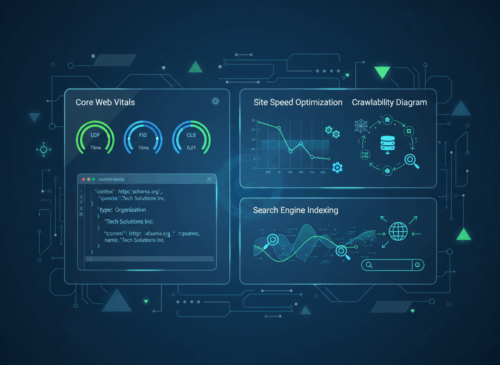
What Our Technical SEO Audit Covers
Every engagement starts with a full crawl and a prioritized findings report — problems ranked by impact and effort, not a 90-page PDF of everything the tool flagged. You get the findings, the fixes we recommend, and the order to do them in; if you want us to implement, we do, in the code rather than a plugin settings page. (Need only the audit? See our SEO audit services.) Here’s what we check, and why each one matters:
Crawlability
robots.txt, XML sitemaps, crawl traps, orphan pages, internal link depth. If Google can’t reach a page efficiently, nothing else about it matters.
Indexation
Canonicals, noindex, redirect chains, duplicate URLs, soft 404s, parameter handling. The wrong pages indexed — or the right pages not — is the most common revenue leak we find.
Core Web Vitals
LCP, INP, and CLS in field data, not just lab scores. A ranking factor and a conversion factor; we’ve taken LCP from 15.2s to 0.8s on a rebuild.
Rendering
JavaScript dependence, lazy-load behavior, above-the-fold delivery. Content that only exists after JS runs is content Google may not count.
Site Architecture
URL hierarchy, breadcrumbs, hub-and-spoke linking, click depth. Architecture is how you tell Google which pages are most important.
Structured Data
Organization, Service, Article, FAQ, Breadcrumb, and LocalBusiness schema — validity and completeness. Schema is how search engines and AI assistants confirm what your pages mean.
Security & Hygiene
HTTPS, HSTS, security headers, mixed content, hosting configuration. Trust signals, and the difference between a stable site and a compromised one.
Mobile
Responsive behavior, tap targets, viewport, mobile-first parity. Google indexes the mobile version of your site — it has to be the complete one.
Why Hire a Technical SEO Agency That Also Builds Websites
Most technical SEO recommendations die in a handoff. The agency writes the report, the developer disagrees with it or deprioritizes it, and six months later the same issues are still there. We don’t have that gap: the people who find the problems are the people who fix them.
We fix it in the code, not in a plugin
Redirect logic, schema output, image pipelines, render-blocking assets — we change the theme and server configuration directly. No stacking plugins to approximate a fix.
Field data, not just lab scores
We measure Core Web Vitals from real Chrome users (CrUX) and Search Console, so improvements are the ones Google actually sees. Lab scores are for debugging.
Built for AI search, too
Clean semantic HTML, complete structured data, fast rendering and consistent entity signals are exactly what ChatGPT, Gemini, Perplexity, and Google AI Overviews need to cite you. Technical SEO is the foundation of our AI search optimization services.
Prioritized, with a rationale
Every finding comes with an impact estimate and a reason. You’ll know why a redirect chain matters more than a missing alt attribute, and you’ll be able to defend the roadmap internally.
Results from Technical Fixes
When we rebuilt Hoppr.ai from Squarespace to custom WordPress, the performance score went from 42 to 94, Largest Contentful Paint dropped from 15.2 seconds to 0.8 seconds, and the SEO score went from 77 to 100 — with Core Web Vitals passing outright. For TBG Homes, a technical rebuild plus content work produced 200% organic traffic growth and a 95% improvement in load time. Those are the kinds of numbers a technical foundation makes possible; the content and links then have something to stand on.
Technical SEO FAQs
What is technical SEO?
Technical SEO is the optimization of a website’s infrastructure — crawlability, indexation, rendering speed, site architecture, and structured data — so search engines can efficiently find, understand, and rank its pages. It’s the foundation that on-page content and off-page links are built on.
What does a technical SEO audit include?
A full crawl of the site plus analysis of Search Console and Core Web Vitals field data, covering crawlability, indexation, redirects and canonicals, page speed, rendering, mobile parity, site architecture, structured data, and security. The deliverable is a prioritized findings report ranked by impact and effort, with specific fixes for each issue.
How much do technical SEO services cost?
A one-time technical SEO audit for a typical small-to-mid-size business site is a fixed-fee project; ongoing technical SEO is usually part of a monthly optimization retainer. Pricing depends on site size and complexity — a 40-page brochure site and a 5,000-SKU WooCommerce store are different jobs. We scope it on the discovery call and quote a flat number.
How long does technical SEO take to show results?
Fixes to crawl and index problems are often reflected within two to six weeks of Google recrawling the affected pages. Core Web Vitals field data updates on a rolling 28-day window, so performance improvements take about a month to fully register. Ranking gains from a stronger foundation typically compound over three to six months.
What’s the difference between technical SEO, on-page SEO, and off-page SEO?
Technical SEO is about the site’s infrastructure and how search engines access it. On-page SEO is about the content and HTML of individual pages — titles, headings, copy, internal links. Off-page SEO is about signals from other websites — backlinks, mentions, and reviews. All three matter; technical problems limit how much the other two can achieve.
Do I need a technical SEO agency or can my developer handle it?
Good developers can implement technical SEO fixes, but they rarely have time to audit for them or keep up with how search engines evaluate sites. The ideal is a team that does both — which is what we are. If you already have a developer, we can deliver the audit and work alongside them.
Does technical SEO help with AI search and ChatGPT visibility?
Yes. AI systems depend on the same fundamentals: fast, crawlable pages, clean semantic HTML, and complete structured data that confirms what your business and pages are. A technically sound site is a prerequisite for being cited by AI assistants, which is why technical SEO is the first step in our AI search optimization work.
Technical SEO Insights

Become a Technical SEO Expert and Boost your Online Presence
The complete technical SEO expert guide: core skills and techniques, when to hire one, the interview questions that matter, red...
Read article
Schema Markup for WordPress: The Complete Implementation Guide
Schema markup for WordPress in 2026: the types that matter, three implementation paths (plugin defaults vs custom code), AI search...
Read article
Title Optimization, Meta Descriptions and HTML Headings
Enhance your pages' visibility and relevance in search engine results with Title Optimization, Meta Descriptions, and HTML Headers.
Read articleFind out what’s holding your site back.
Book a discovery call and we’ll tell you — honestly — whether a technical audit is the right next step or whether your problem is somewhere else. Either way, you’ll leave with a clearer picture.