


Financial Services Web Design
Websites for banks, credit unions, and advisory firms that pass the audit and win the customer.
Custom WordPress web design and development for financial services: WCAG accessibility engineered in and independently verified, branch and rate data synced from one source, a minimal plugin footprint, and structured data that puts every location in local search. Built in Raleigh for institutions across North Carolina and beyond.
Why Financial Services Websites Are Held to a Higher Standard
For a bank, a credit union, a trust company, or an advisory firm, the website is not a brochure. It is a branch. Customers check hours, find locations, compare accounts, open applications, and decide whether an institution can be trusted with their money, often before they ever speak to a person. That puts a financial services website under two kinds of pressure at once: it has to perform like a modern product, and it has to hold up to the scrutiny of regulators, auditors, and compliance officers.
Most financial websites are built by teams that understand one of those pressures and not the other. Marketing-led builds look polished and fail accessibility audits. Compliance-led builds pass the audit and lose the customer on a slow, dated page. And an alarming number run on commercial themes carrying a dozen third-party plugins, each one a piece of someone else’s code on a security-sensitive property.
We build financial services websites on hand-coded WordPress themes with compliance and performance treated as the same project: WCAG accessibility engineered into the markup, privacy and data handling designed in from the start, a minimal plugin footprint, and the structured data that makes a 56-branch network findable in local search. Fidelity Bank, The Trust Company of North Carolina, and Tier 1 Lending all run, or launched, on this approach.
What We Build for Banks, Credit Unions, and Advisory Firms
Scoped to the institution, but these are the components nearly every financial services project needs.
WCAG Accessibility, Verified
Semantic structure, keyboard navigation, contrast, and assistive-technology patterns built into the theme rather than patched on, then verified with independent third-party audit tooling. That is how The Trust Company of North Carolina reached WCAG AA, and it is the difference between claiming accessibility and demonstrating it to a compliance officer.
Branch and Location Data
Secure API integrations that sync branch locations and hours from one source of truth, with LocalBusiness and FinancialService structured data on every location page. For Fidelity Bank, that meant 56 branches across 25 counties that are never wrong in search.
Products, Rates, and Disclosures
Account and loan pages structured so rates, terms, and required disclosures live in one managed place and stay consistent everywhere they appear, with content workflows your compliance team can review before anything publishes.
Interactive Tools and Calculators
Mortgage, savings, and loan calculators built into the site and styled to the brand, with real-time data integrations where they are needed. Tier 1 Lending’s branded, animated mortgage calculator turned a commodity utility into its primary engagement tool.
Security by Subtraction
Every third-party plugin is a maintenance burden and a potential exposure. We build core functionality into the theme instead. Fidelity Bank’s homepage went from seven plugins to one, and the site has been faster and simpler to secure ever since.
Privacy and Data Handling
Forms, analytics, consent, and data retention designed to GDPR and state privacy standards from the start, so the website meets the same bar as the institution behind it.
The Problems We Find Most in Financial Websites
Every engagement starts with an audit. These are the findings that repeat across banks, credit unions, and advisory firms.
Accessibility as a retrofit
An overlay widget or a late-stage audit fix applied to template markup nobody controls. It rarely holds up, and in a regulated industry an inaccessible site is both a lost customer and a compliance exposure.
Plugin stacks on sensitive properties
Commercial themes carrying a dozen plugins for sliders, forms, tables, and locators. Each is a performance drag and a piece of unreviewed code running on a site that handles customer intent, if not customer data.
Branch data maintained by hand
Hours and addresses edited page by page, drifting out of sync with the core system and with Google Business Profile, so customers arrive at closed doors and local rankings suffer.
Slow pages on mobile
Heavy hero imagery, unoptimized scripts, and page-builder markup that puts mobile PageSpeed in the red. Customers checking a balance or a rate from a phone do not wait.
Rates and disclosures duplicated
The same rate or disclosure pasted into six pages, updated in five. A structured content model puts it in one place and renders it everywhere.
Nothing machine-readable
No FinancialService, BankOrCreditUnion, or FAQPage structured data, so the institution is invisible to the rich results and AI answers that increasingly sit above the map pack for “bank near me” and “best savings rate” queries.
Compliance and Performance Are the Same Project
The instinct in financial services is to treat accessibility, privacy, and security as a checklist applied after the site is designed. It is faster, cheaper, and far more durable to make them properties of the code itself. Semantic HTML serves screen readers and search crawlers alike. A theme that carries only the code it needs is faster to load and has less surface to secure. Structured branch and product data is easier to keep accurate for regulators and easier for Google to trust. We build to that principle on every financial services project, which is why the same rebuild that made Fidelity Bank’s homepage 85% lighter also delivered its accessibility and privacy compliance as structure rather than patchwork. Our page speed and AI optimization services cover the technical side in more depth.
How a Financial Services Website Project Works
Audit and compliance baseline.
We audit the current site for accessibility, performance, security exposure, and search visibility, and record the baselines your compliance and marketing teams will measure against.
Architecture and content model.
Products, rates, disclosures, locations, people, and resources modeled so each lives in one place, with review workflows that fit how your institution approves content.
Build, integrate, verify.
A hand-coded WordPress theme with branch, rate, and tool integrations built in, WCAG conformance verified with independent tooling before launch, and every existing URL mapped and redirected.
Launch and care.
Daily monitoring through the first week, then an optional care plan covering updates, security, backups, and performance checks so the site stays compliant as it grows.
Financial Services Work
A community bank, a trust company, and a mortgage lender, each on a custom WordPress build designed for compliance, speed, and search.

Fidelity Bank
Custom WordPress rebuild for Fidelity Bank: WCAG and GDPR compliance engineered in, custom branch locator APIs, and a fast, plugin-free foundation.
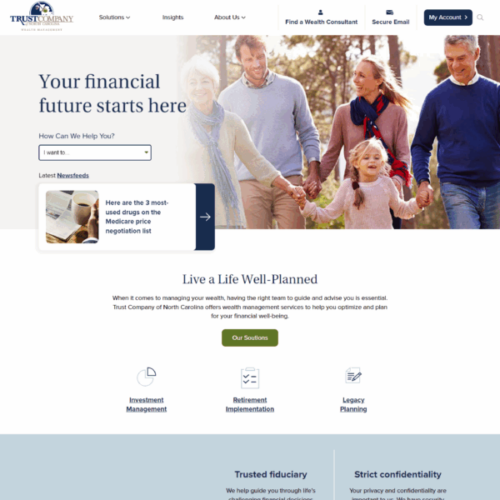
Trust Company
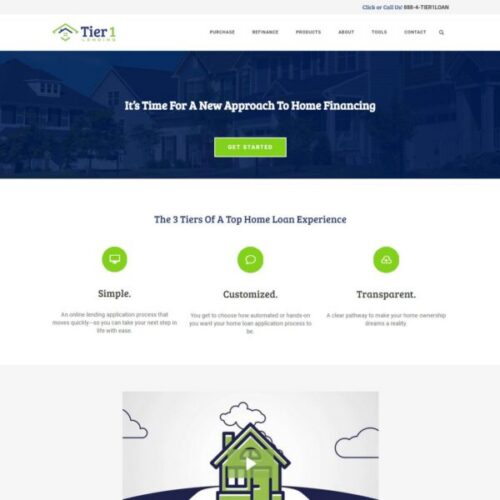
Tier 1 Lending
A new Dallas mortgage lender launched on a custom WordPress site with branded iconography, an animated…
Custom Development · Design · WordPress
Cordell & Cordell
Financial Services Website Questions, Answered
Does a bank or credit union website have to be ADA compliant?
Financial institutions are among the most frequent targets of website accessibility complaints and lawsuits under the Americans with Disabilities Act, and regulators increasingly expect digital channels to be accessible to customers who rely on assistive technology. The practical standard is WCAG 2.1 or 2.2 at level AA. We build accessibility into the theme markup itself (semantic structure, keyboard navigation, contrast, labeled forms, accessible components) and then verify conformance with independent third-party audit tooling, so the institution has evidence rather than an assertion. That is how The Trust Company of North Carolina reached independently validated WCAG AA on its rebuild.
Is WordPress secure enough for a bank website?
WordPress itself is as secure as the code running on it. The risk on most financial sites is not the platform but the stack of third-party plugins layered on top of it, each one code the institution did not write and rarely reviews. Our approach is security by subtraction: build the functionality into a custom theme, keep the plugin footprint minimal, and host on managed infrastructure with a care plan that keeps everything current. Fidelity Bank’s rebuild took the homepage from seven plugins to one. Transactional systems (online banking, applications) stay on their dedicated, audited platforms; the marketing site integrates with them securely rather than trying to replace them.
How do you keep branch hours and locations accurate across a bank website?
By not maintaining them by hand. We build secure integrations that sync location and hours data from a single source of truth into every branch page, the locator, and the structured data search engines read. When a branch changes its Saturday hours, it changes once and is correct everywhere, including in the local search results that send customers to the door. For Fidelity Bank that meant 56 locations across 25 counties that never drift out of sync.
Can you build mortgage or savings calculators into the site?
Yes, and we prefer to build them into the site rather than embed a third-party widget. A calculator designed to the brand, animated and fast, keeps visitors engaged at the highest-intent moment and feeds leads directly into the institution’s intake. Where live data is needed, such as current rates, we integrate securely with the source system so the tool stays accurate without manual updates. Tier 1 Lending’s branded, animated mortgage calculator was the centerpiece of its launch site.
How do you handle compliance review before content publishes?
We design the content model around how the institution actually approves things. Rates, disclosures, and product terms live in structured fields rather than free text, so they appear consistently everywhere and can be reviewed in one place. Editorial roles and review steps are configured so marketing can draft and compliance can approve without a developer in the loop, and every change is versioned so there is a record of what was live when.
How long does a financial services website project take?
It depends on the scope: the number of products and locations, the integrations involved, whether the project includes a migration, and how many review cycles the institution’s compliance process requires. A single-location advisory firm is a very different project from a multi-county bank with branch integrations. We scope each project individually after a discovery call and an audit of the current site, and quote a fixed price and a realistic timeline before work begins.
Ready for a financial website that passes the audit and wins the customer?
Tell us about your institution and what your current site is costing you in compliance risk, speed, or lost customers. We will show you exactly how we would approach it, with no obligation.