


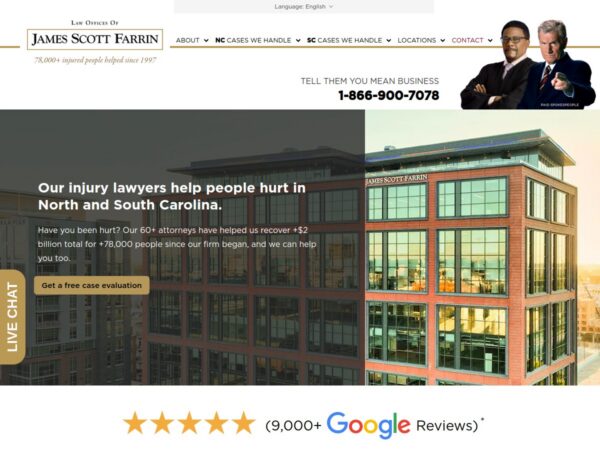
James Scott Farrin: Moving a 15-Office Law Firm Off a Proprietary Platform and Onto WordPress
Client: Law Offices of James Scott Farrin
Industry: Legal, Personal Injury and Workers’ Compensation
Timeline: Launched December 2020
Services: Custom WordPress Development, Platform Migration, Performance Optimization, Technical SEO
The Challenge
The Law Offices of James Scott Farrin is one of the largest personal injury firms in North Carolina: founded in 1997, headquartered in Durham, with 60+ attorneys across 14 North Carolina offices and one in South Carolina. The firm reports recovering more than $2 billion in total for more than 78,000 people, and its website is where a large share of those clients first make contact.
Before the rebuild, farrin.com ran on a proprietary, vendor-hosted platform rather than WordPress. That arrangement had a familiar cost for a firm of this size. Every content change, landing page, and template adjustment went through the vendor, the firm did not own the code behind its most important marketing asset, and a content operation that needed to publish hundreds of practice-area and location pages was working inside someone else’s system.
For a personal injury firm, the site also has to do more than look credible. It competes in one of the most expensive keyword markets in search, it takes a steady stream of free case evaluation requests, and it has to load quickly for people who are often filling out a form from a phone in a difficult moment.
The Approach
- A custom WordPress theme built from a clean starter, not a page builder. The theme was written specifically for the firm’s content model: practice areas, attorney profiles, office locations, results, and a large library of articles, each with templates designed for that content rather than assembled block by block.
- A full migration off the proprietary platform. The firm’s existing pages, URL structure, and search equity were carried over into WordPress so the launch did not reset years of rankings for competitive personal injury terms.
- A deliberately small plugin footprint. The site launched with two plugins loading on the homepage, page caching and forms. Functionality that would normally come from a stack of plugins was built into the theme instead.
- Forms and conversion paths treated as core features. Free case evaluation forms were integrated directly into the templates so that every practice-area and location page carries the firm’s primary call to action without extra weight.
- Technical SEO built into the templates: structured headings, clean markup, and location and practice-area architecture designed for how the firm’s prospective clients actually search.
The Results
The new farrin.com went live in December 2020 and put the firm in control of its own website for the first time, on a platform its team could publish to directly. Search visibility followed. According to Semrush, farrin.com ranked for about 4,980 keywords with an estimated 5,300 monthly organic visits in November 2020, the month before launch. Twelve months later it ranked for 12,900 keywords with an estimated 20,500 monthly organic visits, a 286% increase in organic traffic. By August 2026 the same site ranked for 22,600 keywords and drew an estimated 62,500 organic visits a month, nearly twelve times the pre-launch figure.
Archived copies of the homepage show the site launching with just two plugins, and the same custom theme is still in production more than five years later, having carried the firm through steady growth: back-to-back Triangle Business Journal Fast 50 honors in 2024 and 2025 and a place on the Triangle Business Journal list of the largest North Carolina metro area law firms in 2025. A theme that survives five years of daily publishing by a 60-attorney firm, without needing to be replaced, is the clearest measure of whether a foundation was built correctly.
Key Takeaways
Own the platform your growth depends on. A vendor-hosted site is convenient until the first time you need something the vendor does not offer. Moving to a custom WordPress build gave the firm full ownership of its code, its content, and its roadmap.
Migrations should protect rankings, not gamble with them. For a firm competing on personal injury terms, preserving URL structure and search equity through the move was as important as the new design.
Longevity is a performance metric. Purpose-built templates and a two-plugin launch produced a site that has stayed fast and maintainable through five years of growth instead of accumulating the bloat that forces a rebuild.
Related
This project is one of the examples in our guide to law firm web design, which covers what we build for firms, the problems we find most often in legal websites, and answers to the questions we hear from firms on discovery calls.