
Why PHP Still Matters in 2026: The Real Threats (and Why It’s Still Winning)

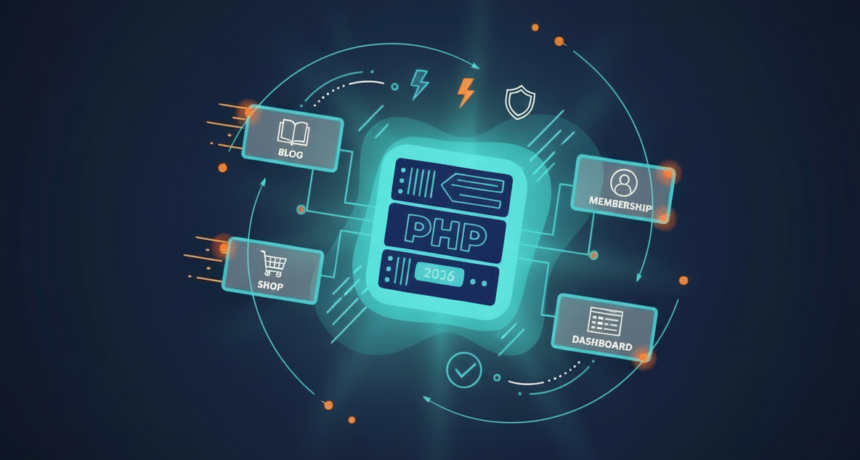
PHP gets declared “dead” on a predictable cycle. Meanwhile, the web keeps shipping server-rendered HTML backed by databases and infrastructure that values stability over hype.
If you build websites for real businesses (marketing sites, content hubs, membership platforms, eCommerce, internal tools), PHP remains one of the most practical ways to deliver durable, maintainable work into production.
Quick answer: Is PHP still relevant?
Yes. PHP still powers a large portion of the web, and its future is tied less to trend cycles and more to how the internet actually runs: request/response pages, CMS-driven publishing, and commerce.
Reality check: PHP still runs a huge chunk of the web
Multiple industry trackers continue to show PHP as the most common server-side language on public websites. For example, W3Techs’ PHP usage statistics track PHP across sites where the server-side language is known.
WordPress is also a major driver of PHP’s footprint; WordPress publishes its own project overview and ecosystem context on the WordPress “About” page.
If you’re evaluating “future-proof,” it’s hard to ignore the installed base: the CMS ecosystem, plugin economy, and hosting infrastructure built around PHP.
Why PHP keeps surviving: it matches how the web is built
1) It’s built for request/response workloads
PHP’s lifecycle—start, handle request, exit—is a feature for many web workloads. It naturally limits long-running memory issues and isolates failures to a single request.
That’s a big reason PHP thrives in shared hosting and high-volume, cost-sensitive environments.
2) Deployment is simple (and the feedback loop is fast)
Many PHP workflows still avoid heavy build steps. You change code, deploy, and the server runs it.
That tight loop matters when you’re shipping client work, iterating quickly, or maintaining large sites where reliability beats novelty.
3) The ecosystem is massive—and business-critical
Even if you don’t write “raw PHP,” you’re likely touching it via:
- WordPress (see the WordPress project overview)
- WooCommerce (in the WordPress ecosystem)
- Drupal
- Laravel (see the Laravel documentation) and Symfony (see the Symfony documentation)
- Moodle
These aren’t niche tools, they’re the backbone of publishing and commerce for millions of businesses.
Modern PHP is not the PHP people love to dunk on
A lot of PHP’s reputation is anchored in 2008–2015 era tutorials and codebases.
Modern PHP (especially PHP 8+) supports stricter, more predictable engineering. The PHP project maintains a clear release history and feature notes on the official PHP releases page.
Key shifts that changed the game:
- Stronger typing features (typed properties, union types, return types)
- Major performance improvements since PHP 7
- Better security defaults and modern database access patterns (PDO + prepared statements)
On the security side, if you want a canonical reference for why prepared statements matter, OWASP’s SQL Injection Prevention Cheat Sheet is a strong link target.
If your mental model of PHP is “loose, slow, insecure,” you’re arguing with an older version of the language.
AI doesn’t kill PHP, it reduces maintenance friction
AI tools don’t “discriminate” much by language popularity. If a language has a huge footprint, lots of examples, and consistent patterns, AI assistants can be effective at generating, refactoring, and debugging it.
PHP benefits because:
- There’s an enormous corpus of PHP code in the wild
- Common web tasks are well-trodden
- Framework conventions (see Laravel and Symfony) provide repeatable patterns
The likely future isn’t “AI replaces PHP devs.” It’s:
- AI lowers the cost of maintaining and modernizing PHP codebases
- Teams ship faster without rewriting everything in a new stack
That’s a survival advantage.
What could actually threaten PHP long-term
PHP won’t disappear because a “better language” exists, better languages have existed for decades.
PHP loses share mainly if the underlying architecture of the web shifts to a place where PHP no longer fits.
1) “One language” teams (JavaScript everywhere)
For many orgs, the strongest argument against PHP isn’t syntax—it’s staffing.
If a team can hire full-stack JavaScript developers and run one language across frontend and backend, that reduces context switching and organizational friction.
2) Serverless-first architectures
PHP’s request lifecycle doesn’t map perfectly to some serverless environments that favor warm processes and shared state. You can make it work, but the fit is often more natural with runtimes designed for that model.
3) AI tooling gravity (Python)
The AI ecosystem is heavily Python-centered. If more products become “AI-native” and want one runtime end-to-end, PHP may be less attractive for greenfield builds.
But PHP doesn’t need to “own AI” to remain valuable. It needs to keep being excellent at web delivery, content systems, commerce, and integration-heavy business apps.
So… what’s PHP’s future?
PHP’s future looks a lot like its present, but more modern:
- WordPress and CMS-driven web stays enormous (see WordPress overview)
- Laravel (see Laravel docs) and Symfony (see Symfony docs) keep PHP relevant for serious application development
- Modern practices become the norm (typing, testing, CI, static analysis)
- AI accelerates maintenance and migration, making modernization cheaper than replacement
Practical advice: what to build in 2026
Choose PHP when:
- You’re building on WordPress/WooCommerce or a PHP CMS
- You want fast, reliable request/response web delivery
- You’re optimizing for cost, hosting flexibility, and a huge hiring pool
- You’re modernizing an existing system and want performance/security gains without a full rewrite
Consider other stacks when:
- You’re building an AI-first product where Python is the center of gravity
- You’re deeply serverless/event-driven and want a runtime designed for that model
- Your org is committed to a single-language strategy (often JavaScript)
“Dead” languages don’t power most of the internet
PHP isn’t a punchline. It’s infrastructure. And infrastructure doesn’t win by being exciting—it wins by being dependable.
If you’re still writing PHP, you’re not behind, you’re working on the part of the web that actually pays the bills.