


Why Your 2026 Digital Marketing Strategy Needs a Major Upgrade
AI search, social SEO, privacy-first analytics and video are rewriting the playbook. What to drop, what to add, and how to future-proof your brand in 2026.

If you’re still running the same digital marketing playbook from 2023 or 2024, you’re not just behind, you’re invisible. The rules have changed at every level: how people search, how they discover brands, how they shop, and how they decide to trust you. The gap between businesses that have adapted and those that haven’t has never been wider. Here’s what’s driving the shift, and what you can actually do about it.
1. AI Search Has Replaced the Blue Link
Google’s AI Overviews, ChatGPT, Perplexity, and Gemini have fundamentally changed how people find information online. The old game was ranking on page one. The new game is being cited by AI.
To show up in AI-generated answers, your site needs to be structured for machine readability, not just human readers. That means:
- Semantic HTML with clear heading hierarchies
- JSON-LD schema markup for your business, services, and content types
- Direct-answer content blocks: FAQs, HowTo sections, and definition paragraphs
- Entity-rich copy that connects your content to recognized topics, people, and places
- Writing for natural language queries, not keyword density
Topical authority matters more than ever. AI models favor sites that cover a subject thoroughly and consistently over sites that hit a keyword once and move on. If you don’t already have a content hub or pillar-and-cluster architecture, building one should be a priority this year. For a deeper look at what it actually takes to optimize your site for AI visibility, we’ve covered the technical and content side in detail.
Google provides official documentation on structured data implementation if you want to go straight to the source on schema requirements.
2. Social Platforms Are Now Search Engines
TikTok, YouTube, Instagram, and Pinterest have become the first stop for a growing share of buyers, especially Millennials and Gen Z. People use these platforms the same way they once used Google: with specific, intent-driven queries like “best CPA near Raleigh” or “how to fix a leaky faucet.”
Social SEO is its own discipline now, and it’s different from traditional SEO. A few fundamentals:
- Write captions and video descriptions for search, not just engagement. Use natural language phrases your audience actually types.
- Treat hashtags as topic tags, not reach hacks. Specific, relevant hashtags outperform broad ones on most platforms.
- Build topic clusters across your social content the same way you would on your website. A series of connected videos or posts on a single subject builds platform authority over time.
- Link social content to landing pages designed to convert that specific audience. A discovery-stage viewer needs a different page than someone who already knows your brand.
Search intent still drives everything, whether the search happens on Google or TikTok. Our guide to intent-first SEO and Google Ads strategy for 2026 covers how to think about intent mapping across channels.
3. Short-Form Video Is a Full-Funnel Channel
Short-form video isn’t a brand awareness tactic anymore. In-app checkout, creator storefronts, and shoppable video are now expected parts of the buying experience on TikTok, Instagram, and YouTube Shorts. Video has moved into the consideration and conversion stages, and brands that treat it as top-of-funnel only are leaving revenue on the table.
The good news: high production value is not the deciding factor. Repurposed blog content, founder story clips, product walkthroughs, and behind-the-scenes footage consistently outperform polished brand videos on most platforms. What matters is specificity, authenticity, and a clear next step.
A few practical starting points:
- Audit your existing blog content for posts that could become a 60-second explainer or listicle video.
- Add video embeds at key decision points on your website, not just your homepage or blog.
- Track video content through to conversion, not just views and watch time. If your analytics setup doesn’t connect social video to pipeline outcomes, fix that first.
4. AI Can Scale Your Content, but Your Voice Still Wins
Every marketer has access to AI content tools now, which means AI-generated content is everywhere and increasingly undifferentiated. The brands winning in 2026 are using AI to accelerate research and ideation while investing in original expert perspective, real-world examples, and a recognizable brand voice.
Search engines and AI models are both getting better at identifying shallow, templated content. The signals they reward are topical depth, first-hand experience, consistent authorship, and specificity. Generic is getting penalized, not just ignored. HubSpot’s 2026 State of Marketing report found that using AI to create personalized content is now the single top marketing trend, cited by nearly half of marketers surveyed, which tells you how crowded the space has become.
A sustainable AI-assisted content workflow looks something like this: use AI to research, outline, and identify gaps, then have a subject matter expert write or heavily edit the actual content. Publish under a named author with a real bio. Link internally to supporting content. Update it regularly. This isn’t a workaround. It is just good content practice that happens to align with how AI models evaluate credibility. We break down exactly how answer-first content earns AI citations, and how to test your brand’s visibility across AI models.
If you’re wrestling with how traditional SEO and AI SEO fit together, our post on whether AI SEO doubles your workload addresses that directly.
5. Third-Party Cookies Are Gone. Your Data Strategy Has to Change.
The deprecation of third-party cookies isn’t a future concern, it is the current reality. If your analytics, retargeting, and attribution still depend on third-party data, you’re already flying blind in ways you may not fully see yet.
First-party data is what you collect directly: email signups, form submissions, purchase history, on-site behavior. Zero-party data is what users proactively share with you: quiz answers, preference surveys, onboarding responses. Both require intentional design and genuine value exchange to collect at scale.
Practical steps to take now:
- Audit your current analytics setup. Are you capturing meaningful first-party events, or are you still relying on third-party pixels for attribution?
- Implement server-side analytics to improve data accuracy and reduce dependence on browser-based tracking.
- Build opt-in flows that offer real value: content downloads, personalized recommendations, early access, member-only resources. Consent has to be earned.
- Treat your email list as a core business asset. It’s the most durable owned audience you can build.
The technical foundation underneath all of this matters too. Site performance, security, and crawlability directly affect how well your data and content strategies execute. Our technical SEO guide covers the fundamentals worth auditing first.
6. Connected TV Belongs in Your Performance Stack
Connected TV (CTV) has earned a seat alongside paid search and paid social for brands with the budget to support it. Precise audience targeting, IP-level household matching, and improving attribution tools mean CTV is no longer just expensive reach. It can be measured and optimized like any other performance channel. IAB’s 2026 Digital Video Ad Spend and Strategy report puts total US digital video ad spend above $80 billion this year and projects connected TV growing close to 14% year over year, which tells you how much performance budget has moved into the channel.
The caveat: CTV only performs well when it’s integrated. It needs to be connected to your CRM, retargeted against your existing segments, and measured alongside your other digital channels in a unified attribution model. Running CTV in isolation is how brands end up with impressive reach numbers and no clear revenue impact.
If you’re earlier in your marketing maturity, nail your search, social, and email fundamentals first. CTV is a multiplier. It amplifies a strong foundation, it doesn’t substitute for one. For a closer look at how paid channels like Demand Gen fit into the broader mix, see our breakdown of Demand Gen vs. Display.
7. Close the Loop Between Marketing and Sales
Traffic and leads only matter if they’re connected to revenue. The best-performing brands in 2026 have eliminated the handoff gap between marketing activity and sales outcomes, connecting their website, content, and ad platforms directly to their CRM and sales workflows.
In practice, that means automated lead scoring based on content engagement, retargeting triggers that respond to specific on-site behavior, and sales teams who can see which touchpoints influenced a deal before they make the first call. It also means marketing reporting that speaks in revenue, not just impressions and clicks.
If your marketing and sales teams are still working from separate data sources, aligning them around a shared attribution model is one of the highest-leverage things you can do this year. And if your website itself is a bottleneck, slow to load, hard to crawl, or poorly structured, that’s worth solving first. See how AI-ready architecture drove 200% traffic growth for TBG Homes to see what that kind of foundation can do for pipeline.
The Bottom Line
2026 isn’t about choosing one tactic and going deep. It’s about building a system where discovery, engagement, and conversion work together across AI search, social SEO, video, and owned data, and where every part of that system is measured in a way that ties back to real business outcomes.
The brands that fall behind this year aren’t failing because they lack budget. They’re failing because they’re still thinking in isolated campaigns instead of connected systems. Start with your biggest gap, fix it thoroughly, and build from there.
At City of Oaks Marketing, we help North Carolina businesses build, optimize, and scale digital strategies designed for where the market is going. If you’d like a second set of eyes on your current strategy, we’d love to talk.
Ready to modernize your marketing strategy?
Contact us for a custom strategy session.
More Insights

AI Model Testing Prompt Template for Your Brand: A Complete Guide to AI Brand Visibility
A copy-and-paste prompt template to audit your AI brand visibility: see how ChatGPT, Gemini and Perplexity describe your business, and...
Read article
AI SEO Isn’t Replacing Traditional SEO—It’s Doubling Your Workload (And Here’s Why That’s Good News)
Why traditional SEO and AI optimization are one job, not two, plus 12 tactics to get cited by ChatGPT, Perplexity...
Read article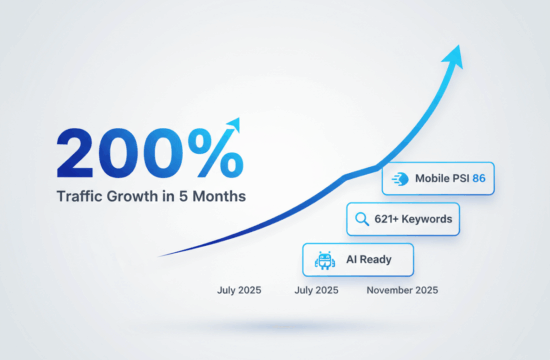
How AI-Ready Architecture Delivered 200% Traffic Growth in 5 Months: TBG Homes Case Study
How AI-ready architecture, custom WordPress and technical SEO delivered 200% organic growth and 621+ keyword rankings for TBG Homes in...
Read article